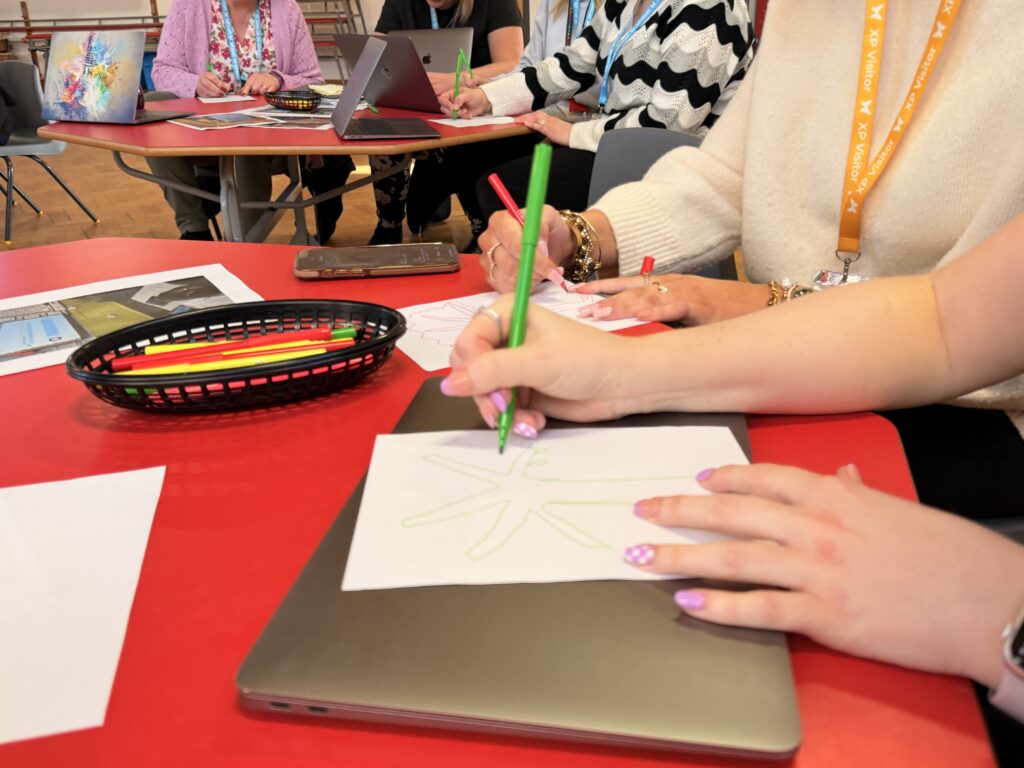
“Draw a tree.”
That was the instruction.
Thirty seconds later, the room was full of trees — tall ones, careful ones, hurried ones, hesitant ones.
Then we added the success criteria.
The tree needed:
- Visible roots
- Exactly five branches
- At least three leaves per branch
- A labelled trunk
The laughter came first. Then the checking. Then the mild frustration.
“You didn’t say that.”
Exactly.
Nobody in the room lacked the ability to draw a tree. But many hadn’t met the criteria — not because they couldn’t, but because they didn’t know what success looked like.
Ability wasn’t the barrier. Access was.
And that became the anchor for our CPD on inclusive classrooms.
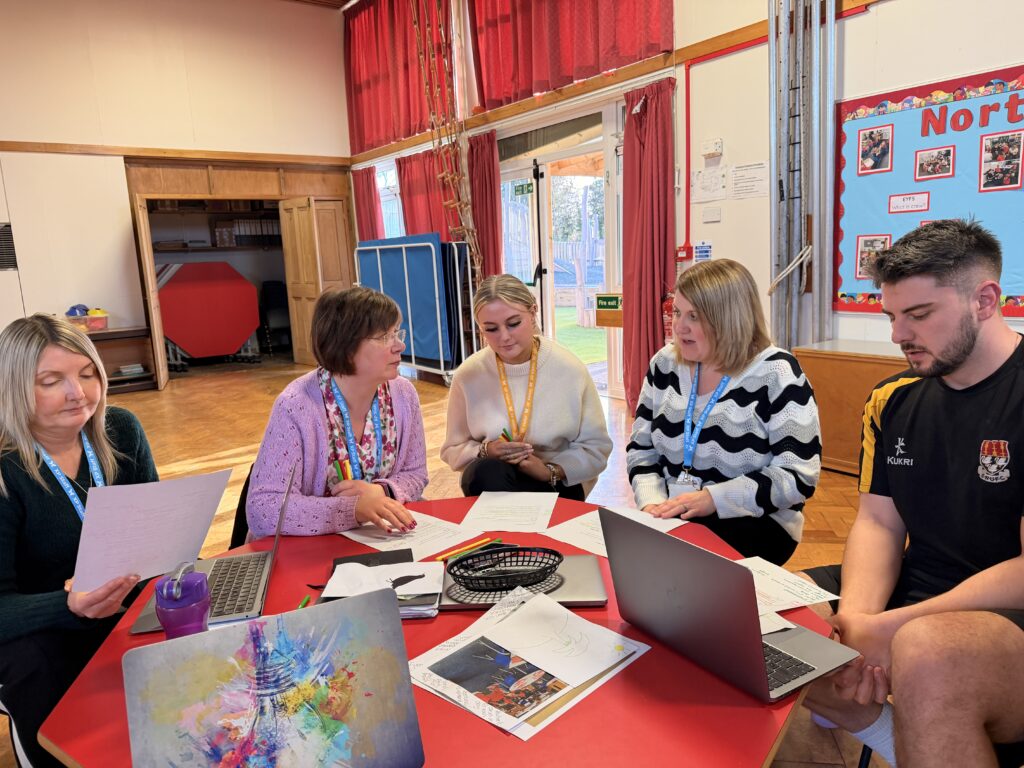
What Does an Inclusive Classroom Look Like?
We began with a simple question:
What does an inclusive classroom look like, sound like and feel like?
Colleagues spoke with real honesty and professional courage. There was integrity in the discussion — a willingness to examine our own provision rather than describe an idealised version of it.
Across the room, themes emerged:
An inclusive classroom manages cognitive load.
It is deliberate about the construction of knowledge.
Teacher talk is purposeful and not excessive.
Assessment for learning is continuous.
Learning is not capped.
Groupings are flexible.
Children are engaged and meaningfully busy.
Instructions are clear and simple.
The language is caring.
Tasks might not all look the same.
Communication is supported — including through Communicate in Print.
And perhaps most powerfully:
“If it works for our more vulnerable learners, it works for all.”
SEND is not a bolt-on.
High-quality provision is the first and most powerful SEND strategy.
Inclusion Must Be Observable
We spent time unpicking lesson scenarios — identifying potential barriers, surfacing adult assumptions, and noticing inclusive strengths.
Across all four phases, similar barriers emerged when:
- Instructions weren’t chunked
- Vocabulary wasn’t explicitly unpacked
- Modelling wasn’t left visible
- Success criteria weren’t concrete
- Anxiety around public error wasn’t considered
- Cognitive load wasn’t deliberately reduced
And inclusion improved when:
- Adult behaviour was deliberate
- Scaffolds were visible
- Expectations remained high
- Processing time was protected
- Participation was structured
Notice what we didn’t do.
We didn’t lower expectations in any scenario.
We didn’t simplify the thinking.
We increased precision.
Inclusion is not about doing more.
It is about doing what we already do — more deliberately.
The Power of Precision
The second time colleagues drew their trees — now with explicit criteria and a visible model — every tree improved.
Not because the adults had suddenly become better artists.
But because the conditions had changed.
Clarity reduces cognitive load.
Visible modelling reduces uncertainty.
Concrete criteria remove guesswork.
Structured participation reduces anxiety.
These are not add-ons. They are the foundations of high-quality teaching.
When inclusion is strong, it is observable. You can see it in the clarity of instruction. You can hear it in the language adults use. You can feel it in the confidence of learners.
And importantly — excellence remains visible.
Knowing the Learner in Front of Us
Precision in instruction is powerful — but it is only part of the picture.
True inclusion also depends on how well we know the individual learners in front of us.
High-quality universal provision reduces barriers for many. But inclusive classrooms are built on something deeper: an understanding of individual needs, strengths, triggers, motivations and starting points.
Planning, therefore, is not about creating separate lessons. It is about anticipating:
- Who might struggle with this vocabulary?
- Who will need processing time protected?
- Who may experience anxiety around public error?
- Who needs scaffolds to remain visible for longer?
- Who requires a different route to demonstrate understanding?
This is not reactive support. It is intentional design.
When we plan with individual learners in mind — not as an afterthought, but as part of the initial thinking — inclusion becomes proactive rather than responsive.
And again, expectations do not lower.
They become clearer.
High Expectations. Reduced Barriers. Observable Excellence.
Inclusion is sometimes misinterpreted as something additional — something layered on once planning is complete.
But the session reinforced something simpler and more powerful:
High-quality provision is inclusive provision.
If we manage cognitive load.
If we make success criteria explicit.
If we model deliberately.
If we protect thinking time.
If we maintain high expectations.
Then we reduce barriers without reducing ambition.
Ability is rarely the barrier.
Access is our responsibility.
And inclusion must be observable.