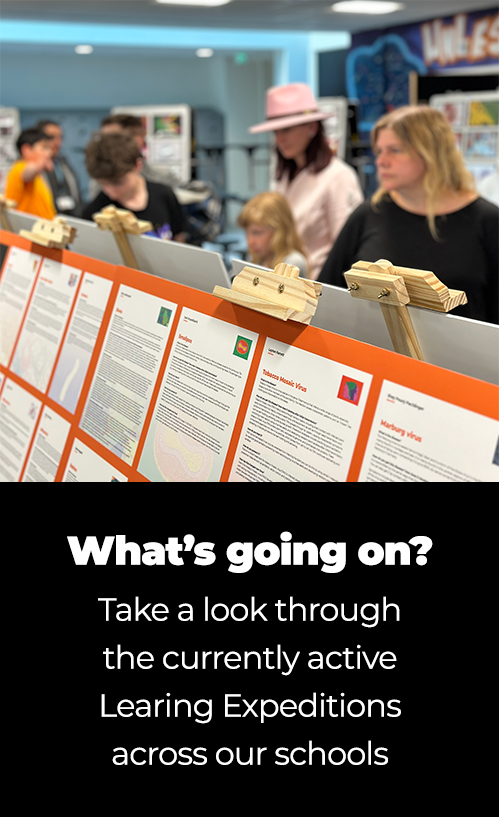
“Has anyone got the latest standards map?”
It’s the sort of question that could be asked in almost any staffroom.
Within moments, the replies begin to appear. One colleague thinks it was emailed a few weeks ago. Another is certain it’s in a drive somewhere. Someone else remembers uploading it to Basecamp but can’t quite remember where. Eventually, after a few minutes of searching, somebody finds it.
Problem solved.
Except, of course, it isn’t really about the standards map.
Moments like these happen every day in schools. They rarely feel significant on their own, but collectively they create something much bigger. They interrupt thinking, slow collaboration and, perhaps most importantly, steal time from the work that matters most. Instead of designing exceptional learning experiences for children, we find ourselves searching for documents, retracing conversations and wondering where the latest version lives.
As we reflected on our own practice at Norton Campus, we found ourselves returning to a deceptively simple question:
What if we designed the way adults collaborate with the same care and intention that we design learning for children?
Designing culture isn’t just for children
One of the ideas that sits at the heart of Expeditionary Learning is that culture is designed.
The environments we create for children don’t happen by chance. Every Crew protocol, every critique session, every learning target and every presentation of learning is intentionally crafted to build not only knowledge, but character, belonging and purpose. We know that beautiful work doesn’t emerge through luck; it grows from thoughtfully designed systems and relationships.
It made us wonder whether the same principle should apply to adults.
If we expect students to collaborate, seek critique, share ideas openly and improve their work through feedback, shouldn’t we be equally intentional about creating the conditions that allow teachers to do exactly the same?
After all, expeditionary learning has never been the work of one individual.
Great expeditions are built together
The very best expeditions rarely begin with one person sitting quietly behind a laptop.
They emerge through conversation.
A colleague recommends the perfect core text that completely reshapes the narrative. Someone else shares a community contact that transforms a classroom project into authentic work with real purpose. A simple question during a planning meeting challenges an assumption, leading to a richer guiding question or a more meaningful final product. Through critique, collaboration and shared expertise, the expedition becomes stronger than any individual could have designed alone.
At Norton Campus, we were already collaborating well. Staff shared ideas generously, supported one another and continually looked for ways to improve the learning experiences we offered our children.
The challenge wasn’t our willingness to collaborate.
The challenge was that our collaboration had become fragmented.
Important conversations lived across emails, chats and informal discussions in the corridor. Resources were stored in different places. Contact details for experts and community partners often relied on individual colleagues’ memories. Previous expedition plans contained a wealth of knowledge, but that knowledge wasn’t always easy to access when it was needed.
None of these issues felt particularly significant on their own.
Together, however, they created unnecessary friction.
Sometimes the answer isn’t something new
Schools are no strangers to new initiatives.
When something isn’t working as effectively as we’d like, our instinct can be to search for another platform, another process or another system that promises to solve the problem.
We consciously chose not to do that.
Basecamp wasn’t new to Norton Campus. We’d used it before, albeit with varying degrees of confidence, consistency and understanding. Some teams had embraced it. Others dipped in occasionally. For many colleagues, it had gradually become another place to look rather than the place where expeditionary work naturally happened.
The issue wasn’t the technology.
It was that we had never collectively established its purpose.
So instead of introducing something new, we decided to redesign something we already had.
What if Basecamp wasn’t simply another digital platform?
What if it became exactly what its name suggests?
A Basecamp.
The place where every expedition begins.
The place where ideas are shared, plans evolve through critique, questions are welcomed, resources are easy to find and great work is celebrated long after an expedition has finished.
Designing for collaboration
As we began reshaping our Basecamp, we deliberately avoided asking questions about features or functionality.
Instead, we focused on people.
What do teachers actually need in order to collaborate well?
- They need to find things quickly.
- They need somewhere to ask questions without feeling they’re interrupting someone else’s day.
- They need opportunities to seek critique before ideas become fixed.
- They need a place where brilliant resources don’t disappear into an email thread, never to be seen again.
- They need somewhere that captures the collective wisdom of a school so that every expedition benefits from those that came before it.
Those conversations shaped everything.
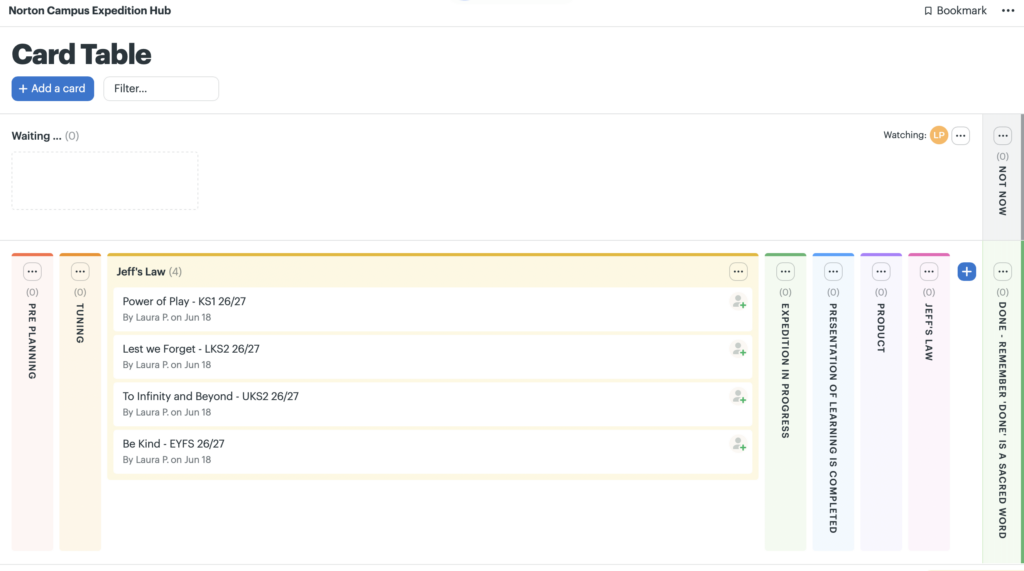
Rather than creating a digital filing cabinet, we designed a shared workspace that mirrors the life of an expedition itself. From the earliest spark of an idea through planning, critique, delivery, Presentation of Learning and final reflection, Basecamp became organised around the journey rather than the documents.
Because ultimately, this was never about technology.
It was about reducing friction so that more time could be spent thinking deeply about learning.
Learning through experience
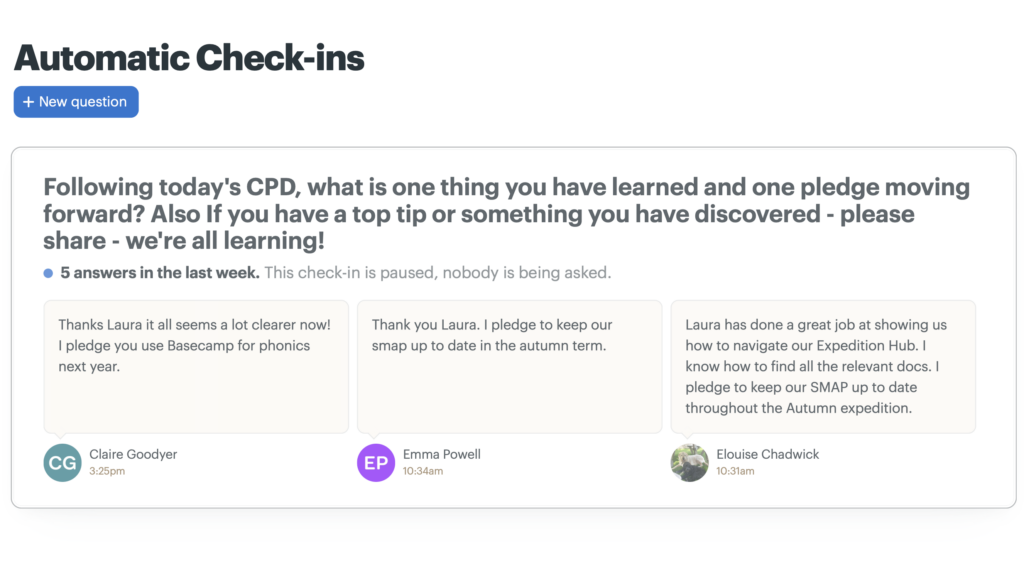
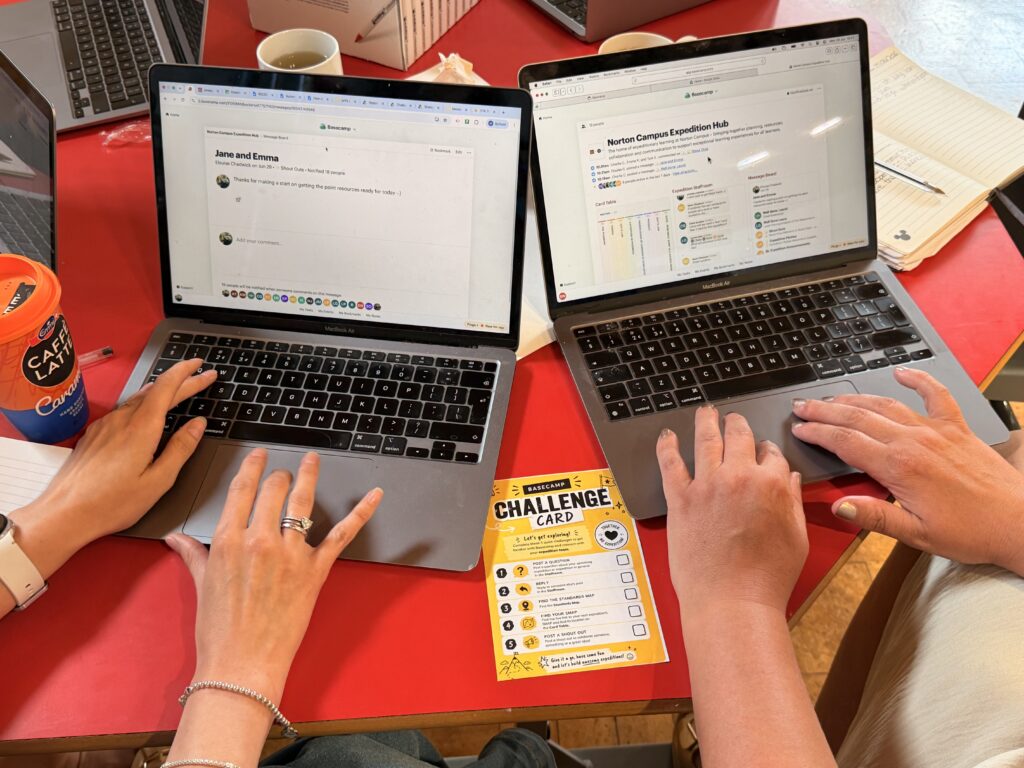
When we introduced our refreshed Basecamp during staff professional learning, we resisted the temptation to spend the morning demonstrating menus and clicking through folders.
Instead, we tried to model the very approach we encourage teachers to take with children.
Learning by doing.
After exploring the thinking behind the project, colleagues worked through authentic scenarios together.
Where would you ask for critique on your guiding question?
Where would you share a brilliant resource you’ve just discovered?
How would you celebrate another team’s Presentation of Learning?
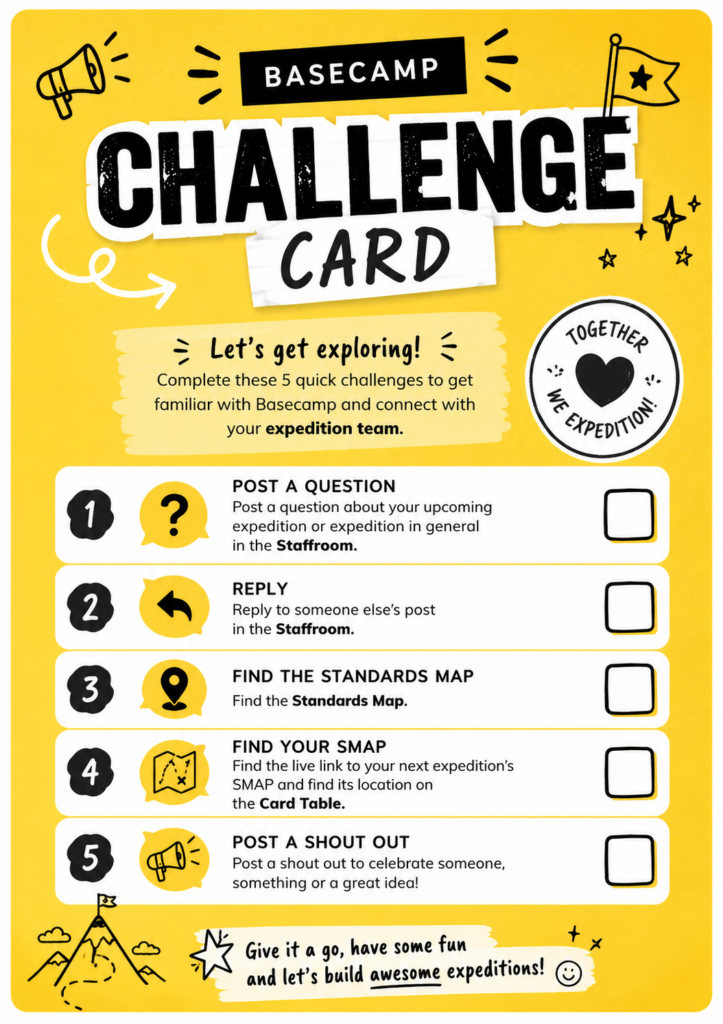
Rather than being told where everything lived, staff completed a playful series of “Basecamp Missions”. They explored the platform for themselves, posted questions in the Expedition Staffroom, replied to colleagues, located standards maps, found their own expeditions on the Expedition Journey and celebrated one another through shout-outs.
The room quickly filled with conversation.
Questions prompted more questions.
Ideas sparked other ideas.
The technology quietly faded into the background, allowing collaboration to become the focus.
Perhaps that was the greatest compliment we could pay the platform.
The platform isn’t the point
Throughout the session we returned to one simple message.
Basecamp isn’t an accountability tool.
- It isn’t another initiative competing for colleagues’ attention.
- It is simply our shared workspace for expeditions.
- If it reduces the number of emails we send…
- If someone finds a standards map in seconds rather than minutes…
- If a colleague feels confident enough to ask for critique before launching an expedition…
If one brilliant idea spreads across the campus because it was shared in the right place…
Then it is doing exactly what we hoped it would do.
No digital platform transforms a school’s culture on its own.
People do.
Technology simply creates opportunities.
It is the habits we build around it—the generosity, curiosity, openness and willingness to collaborate—that ultimately make the difference.
Looking ahead
It would be tempting to end this story by declaring our Basecamp complete.
The reality is quite the opposite.
Like every expedition we design, our Basecamp will continue to evolve. It will improve through critique, adapt in response to feedback and grow alongside the people who use it. New ideas will emerge. Better ways of organising our work will inevitably develop. That’s not a flaw in the system; it’s evidence that the system is alive.
Perhaps that’s the real lesson we’ve taken from this process.
We often speak about designing the conditions for children to thrive.
Maybe we should spend just as much time designing the conditions that allow adults to collaborate brilliantly.
Because when teachers can find what they need, ask thoughtful questions, learn from one another and share their best thinking without unnecessary barriers, everyone benefits.
Most importantly, so do the children.
After all, every great expedition begins with a strong Basecamp.
Discover more from XP Unpacked
Subscribe to get the latest posts sent to your email.